|
TOR LINDQVIST O.A.M.
DR COLIN S WHITE, FSA, FRHistS, MA
- Director of the Royal Naval Museum Portsmouth
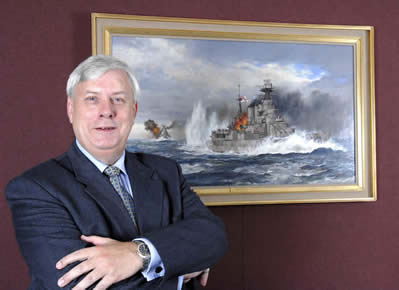
Colin Saunders White died on Christmas Day 2008.
He was born in 1951 and educated at Culford School, Suffolk, Southampton University, and University of London, King's College, where he took an MA in War Studies. He joined the Royal Naval Museum in September 1975 as a research assistant, eventually becoming, in 1995, the Deputy Director and Head of Museum Services, with special responsibility for the Museum's ambitious Development Plan.
At the same time, he came to be recognised as one of the country's leading experts on Nelson. He published three books on him: The Nelson Companion (1995) which is now a best-seller, in its third edition; 1797: Nelson's Year of Destiny (1998): and The Nelson Encyclopaedia (2002).
In 2000, he was appointed Chairman of the Official Nelson Celebrations Committee, with responsibility for co-ordinating The Trafalgar Festival, an ambitious, and ultimately very successful, national and international programme of events to mark the bicentenary of Trafalgar in 2005. His achievement was recognised by the presentation of the Longmans-History Today Trustees Award in early 2006.
In 2001 he was seconded to the National Maritime Museum as Director, Trafalgar 200 to assist the Museum with planning its 2005 initiatives: including a major exhibition, publications and special events.
He also published two major books, both based on original research: Nelson - The new letters and Nelson the admiral. The former was awarded the ‘Distinguished Book Prize’ by the Society for Military History in 2006 and he was also elected a Fellow of the Royal Historical Society. He is also a Vice President of the Navy Records Society and of The 1805 Club.
In 2003, he was elected a Fellow of the Society of Antiquaries. In 2004, he was awarded an honorary Doctorate of Letters (DLitt) by the University of Portsmouth for his contribution to naval history. In 2006, he was awarded the Desmond Wettern Media Award, “For being the most visible spokesman of Britain’s maritime interests in 2005”.
He is probably the only person with the distinction of having been promoted from ordinary seaman RNR (Royal Naval Reserve) to honorary captain RNR, in one step.
A well-known and popular figure on the lecture circuit, he regularly appeared on radio and television talking about maritime affairs. In 2005, he presented his own series on Radio 4, Nelson: the latest news.
He was appointed Director of the Royal Naval Museum in June 2006.
(Source: Royal Naval Museum website)
A true Cape Horner ‘crosses the bar’ - TOR LINDQVIST O.A.M.
 The world lost one of its last true ‘Cape Horners’ with the death of Tor Lindqvist in April 2008, at the age of 86. The world lost one of its last true ‘Cape Horners’ with the death of Tor Lindqvist in April 2008, at the age of 86.
Born in Finland, Tor went to sea as a young man before joining his first large sailing ship, the Passat, as an Able Seaman. From 1938 to 1939 Passat carried wheat from South Australia to Europe giving Tor his first contact with Australia where he was eventually to make his home. His next ship was the ‘lucky’ Lawhill which, being a Finnish owned, meant that Tor and the Lawhill’s crew became enemy aliens when the Allies declared war on Finland in 1941. However, the crew agreed to continue working the ship under the South African flag and did so until the end of the war. During this periodTor was one of the two sail-makers aboard; with the largest sail he made being 3,500 square feet and weighing three quarters of a ton when complete.
Tor was a true ‘Cape Horner’ rounding Cape Horn four times and ending his square rig career aboard the Viking & Commodore 11. He settled in Melbourne, with his wife Vikki, and spent some time in Bass Strait shipping before becoming the Foreman Rigger for the restoration and re-rigging of Melbourne’s tall ship, the 680 ton barque, Polly Woodside.
In 1968, Polly Woodside was saved from the ship-breakers by a determined and inspired group of volunteers under the auspices of the National Trust (Vic). From the time that he joined the project in 1977, Tor oversaw every aspect of the work of the refurbishing team of professional merchant seamen and volunteers.
Tor was among the last of the practical and practising seaman with the knowledge, physical strength and ability to tackle the enormous task of transforming an abandoned dirty, rusty coal hulk back to her former glory. His knowledge, skill and dedication were admired and respected by everyone who worked with him and there was no item of Polly’s rigging, hull or deck fittings that he could not name or know how to maintain. In 1988 the work of Tor and his volunteers was rewarded when the ship became the first merchant ship in the world to be awarded a World Ship Trust Medal.
A highly respected seaman, Tor ‘s exceptional contribution to maritime heritage in the preservation of Polly Woodside was formally recognised in 1993 when he was awarded the Order of Australia. A tall, erect figure Tor continued to volunteer at the ship in an advisory, as well as a practical, capacity until very shortly before his death.
A plaque will be placed on the mainmast of Polly Woodside in Melbourne, to commemorate Tor’s 30 years contribution to maritime heritage.
|


